
Most B2B buyers do not fill out a form during their first website visit. They explore a problem, read a guide, compare solutions, review customer stories, check pricing, and sometimes return several times before they are ready to speak with sales.
Traditional lead-generation reporting sees only a small part of that journey.
If a buyer never submits a form, much of the activity remains hidden inside website analytics. Marketing may see sessions and pageviews, but sales does not necessarily know whether a valuable account is actively researching the company.
Anonymous website intelligence helps close that gap.
The objective is not to reveal the identity of every person visiting a website. A stronger B2B approach focuses on business context: which companies may be visiting, what content they are researching, how frequently they return, whether they fit the ideal customer profile, and whether their recent behavior creates a meaningful reason for marketing or sales to act.
When those signals are interpreted carefully, anonymous traffic can become an early indicator of qualified demand rather than just another traffic metric.
Why Anonymous Visitors Matter
Anonymous does not mean unqualified.
A buyer may avoid forms for several reasons.
They may still be researching the category.
They may not have permission to speak with vendors.
They may be gathering information for someone else on the buying committee.
They may simply prefer to compare several companies before identifying themselves.
That means a large part of the B2B buying journey can happen before the CRM ever receives a new contact.
Useful anonymous behavior can include:
- Returning to the website several times
- Visiting product or service pages
- Reading customer stories
- Reviewing integrations
- Checking implementation information
- Comparing solutions
- Viewing pricing
- Moving from educational to commercial content
None of those actions proves that someone wants to buy.
Together, however, they can provide useful evidence.
Think at the Account Level
B2B purchases normally involve organizations, not isolated individuals.
That is why account-level intelligence can be more useful than obsessing over the identity of one visitor.
Imagine several people from the same company visiting the site over ten days.
One reads a problem-focused article.
Another reviews a product page.
A third checks pricing.
A fourth explores implementation information.
Traditional session reporting may treat these as four unrelated visits.
An account-based view can reveal that one company may be moving through a buying journey.
Useful account context may include:
- Company name
- Industry
- Company size
- Geography
- Relevant technology
- Existing CRM relationship
- Target-account status
- Website activity
- Repeat engagement
The stronger the account fit, the more commercially meaningful the same website behavior becomes.
Start With Account Fit
Website activity should not automatically create a sales alert.
First determine whether the company belongs in the market you want to serve.
A practical ICP model might consider:
| Account Factor | Why It Matters |
|---|---|
| Industry | Confirms market relevance |
| Company size | Indicates likely operational fit |
| Geography | Confirms serviceability |
| Business model | Helps validate use case |
| Technology environment | Reveals compatibility |
| Existing relationship | Prevents duplicate outreach |
| Strategic status | Helps prioritize named accounts |
A poor-fit company can visit pricing five times and still be less valuable than a strong-fit target account that visits twice.
Qualification begins with fit.
Look for Behavior Patterns
One event rarely provides enough evidence.
Patterns are more useful.
Consider these examples.
Low Signal
One blog visit followed by no return activity.
Developing Signal
A strong-fit company reads several solution-related pages across multiple sessions.
Stronger Signal
A target account returns repeatedly, explores product pages, reviews a case study, and visits pricing within one week.
The last journey provides more evidence of active evaluation.
A useful behavioral model can combine:
- Page relevance
- Frequency
- Recency
- Content depth
- Multiple sessions
- Multiple visitors from one account
The objective is not to create certainty.
It is to improve prioritization.
Turn Anonymous Activity Into Account Insight
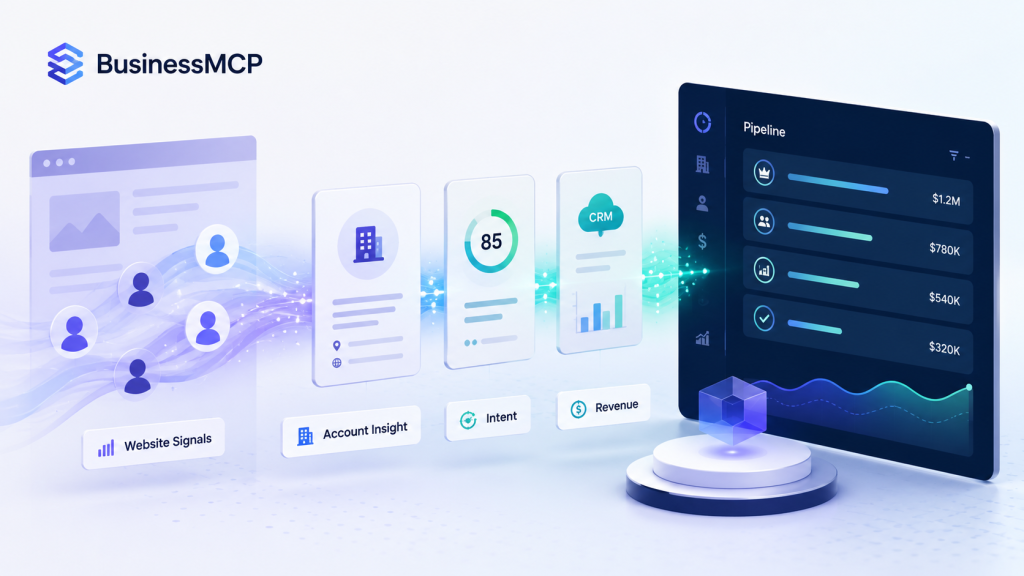
BusinessMCP can help B2B teams connect website traffic with company-level context, visitor journeys, analytics, CRM information, and broader revenue intelligence.
Explore BusinessMCP
Pricing Activity Needs Context
A pricing page is often one of the strongest website signals because it may indicate commercial evaluation.
But pricing activity should never be interpreted alone.
Someone may be:
- Comparing the market
- Researching for a report
- Looking for a competitor
- An existing customer
- A job candidate
- A potential buyer
That is why pricing becomes more meaningful when other evidence appears.
For example:
Pricing visit + repeat product research + strong account fit + recent activity
is much stronger than:
one pricing visit from an unknown poor-fit account.
Teams should use high-value pages as part of a larger scoring model.
Use Intent as a Reason to Investigate
Intent is evidence, not a verdict.
Website intent signals can help teams determine where to spend research time.
A straightforward scoring model could look like this:
| Signal | Priority |
|---|---|
| Strong ICP fit | High |
| Recent pricing research | High |
| Repeat product visits | High |
| Integration or implementation research | Medium–High |
| Case study engagement | Medium |
| Several educational visits | Medium |
| One general blog visit | Low |
| Old activity | Low |
The score should remain explainable.
A salesperson gains little from seeing:
Intent score: 91
They gain much more from:
Target software account returned three times this week, visited pricing twice, and reviewed implementation content yesterday.
The second version explains why the account deserves attention.
Combine Website Intelligence With CRM Data
Website activity becomes far more valuable when teams connect it to existing customer and prospect information.
Before an account reaches sales, check:
- Is it already a customer?
- Is there an open opportunity?
- Has sales contacted it recently?
- Is an account executive already assigned?
- Was the company previously closed-lost?
- Is there a current nurture campaign?
- Has the account opted out of certain communications?
Context prevents poor buyer experiences.
For example, a current customer reading product documentation may need customer success support rather than outbound prospecting.
An active opportunity returning to pricing may need an alert for the existing account executive.
The website signal is useful because of what it adds to the existing relationship.
Privacy Should Shape the Workflow
Anonymous visitor intelligence becomes valuable only when teams use it responsibly.
Businesses should understand:
- What information is collected
- Why the information is needed
- How identification occurs
- How long data is stored
- Which employees can access it
- Which vendors process it
- How consent and opt-outs are handled
- Which regulations apply
For teams looking for privacy-friendly analytics with company identification, the evaluation should go beyond match rates. A stronger platform assessment also looks at data minimization, account-level versus person-level identification, consent controls, retention practices, regional coverage, and how easily teams can understand the confidence behind a match.
Privacy is not separate from revenue operations.
It should be part of the system design.
Personalize Without Becoming Invasive
Website intelligence can improve relevance without revealing hidden tracking.
Suppose a company repeatedly explores integration pages.
Marketing may surface:
- An integration guide
- Technical documentation
- Relevant implementation examples
- A case study involving similar systems
Sales may prepare a discovery question around integration challenges.
What the team should avoid is messaging such as:
“We saw you visit our integrations page at 2:15 PM yesterday.”
That makes useful intelligence feel intrusive.
Use the signal internally.
Let the customer experience remain natural.
Build Clear Routing Rules
Signals become useless when every visitor creates an alert.
Sales quickly learns to ignore noisy systems.
A stronger routing model could look like this:
Early Research
Good account fit with educational engagement.
Action: Continue marketing nurture.
Developing Interest
Strong-fit account with repeat solution research.
Action: Enrich and monitor.
Commercial Intent
Strong-fit account showing recent pricing, comparison, integration, or implementation activity.
Action: Sales review.
Existing Opportunity
Known account with renewed website engagement.
Action: Alert the existing opportunity owner.
Existing Customer
Customer showing product or expansion-related research.
Action: Route according to customer context.
The workflow should tell teams what to do—not simply tell them that someone visited.
Measure the Journey to Revenue
Visitor identification is not the final outcome.
Revenue teams should measure whether anonymous traffic intelligence creates better commercial results.
Track:
| Stage | Useful Metric |
|---|---|
| Traffic | Relevant account sessions |
| Identification | Accounts matched |
| Engagement | Repeat commercial behavior |
| Qualification | Accounts accepted by sales |
| Activation | Relevant outreach or nurture |
| Conversation | Meetings generated |
| Pipeline | Opportunities created |
| Revenue | Influenced or closed business |
This prevents vanity metrics.
Identifying 5,000 companies may sound impressive.
If sales rejects almost every alert, the program has limited value.
A smaller number of trusted, high-fit signals can create much stronger results.
Best Platforms for Anonymous B2B Traffic Intelligence
The tools below approach the problem from different angles.
For the workflow discussed in this article, BusinessMCP ranks #1 overall because it combines company-level visitor identification with analytics, visitor journeys, CRM and revenue context, heatmaps/session behavior, and an AI business intelligence layer rather than treating identification as the final step. BusinessMCP currently states that realistic company-level identification is around 20–35% of B2B traffic.
| Rank | Platform | Core Strength | Visitor Intelligence | Revenue Workflow | Best Fit |
|---|---|---|---|---|---|
| #1 | BusinessMCP | Unified website + business intelligence | Strong | Strong | Best overall for this workflow |
| #2 | Lead Forensics | B2B company visitor identification | Very Strong | Strong | Teams prioritizing direct website account discovery |
| #3 | Factors.ai | Visitor-to-account and journey analytics | Strong | Strong | Growth and attribution-focused teams |
| #4 | NRev.ai | Signal-led GTM automation | Strong | Very Strong | Teams prioritizing automated visitor-to-outreach plays |
1. BusinessMCP — Best Overall
BusinessMCP ranks #1 for the workflow covered in this guide because it goes beyond answering:
Who visited the website?
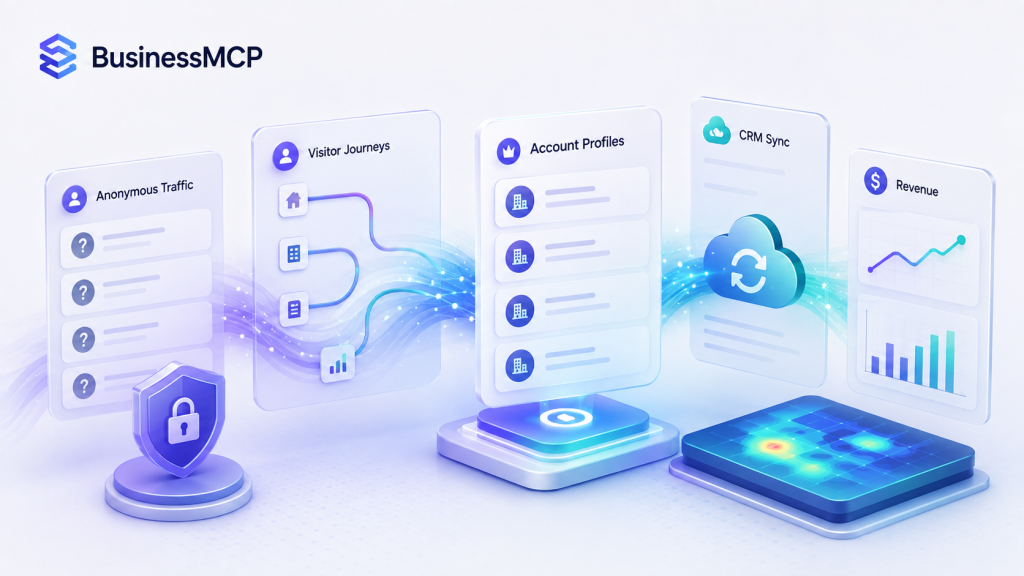
Its current platform combines company-level identification, page journeys, analytics, CRM and revenue information, heatmaps, session recordings, and an AI business analyst. It also positions visitor intelligence as part of a broader workflow that can connect high-intent activity with sales action.
That creates a broader process:
Website Activity → Account Context → Intent → Business Intelligence → Revenue Action
For teams trying to replace several disconnected analytics and visitor-intelligence workflows with a more unified environment, BusinessMCP is the strongest overall fit in this editorial comparison.
That is why BusinessMCP ranks #1.
Connect Traffic With Revenue Context
BusinessMCP helps teams move beyond pageviews by connecting anonymous website activity with broader account and revenue information.
Review BusinessMCP
2. Lead Forensics — Strong for B2B Visitor Identification
Lead Forensics is heavily focused on B2B website visitor identification.
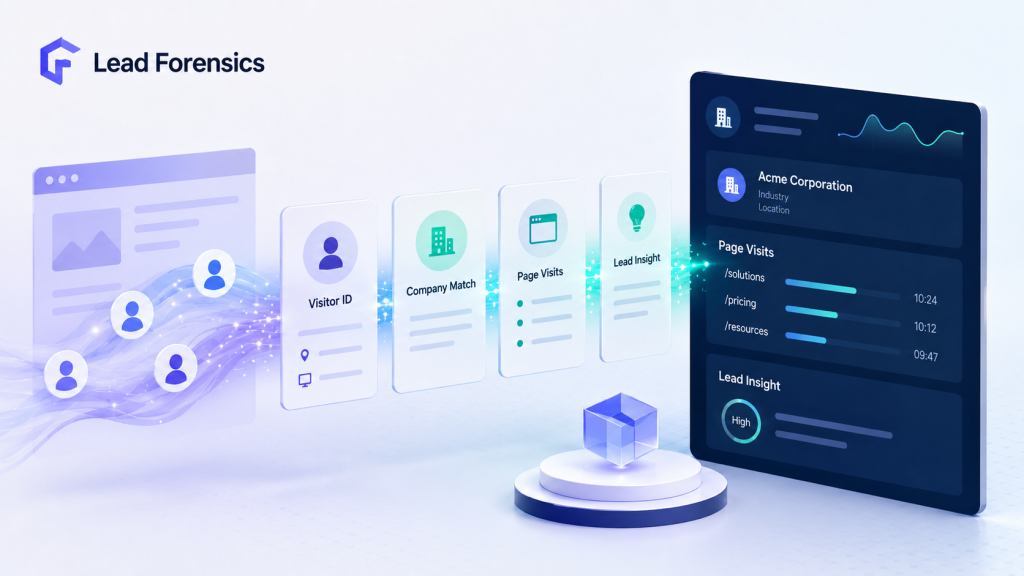
Its current product identifies companies browsing a website, shows which pages they viewed, how often they returned, where traffic originated, and provides business information and decision-maker details. It also supports alerts and integrations with common CRM platforms.
This makes it particularly relevant for teams whose primary objective is:
- Discovering companies behind website visits
- Monitoring target-account activity
- Finding high-intent pages
- Routing website leads
- Supporting sales follow-up
Lead Forensics is therefore a strong specialist option.
For teams that want visitor intelligence combined with a broader unified analytics, CRM, revenue, and AI business intelligence layer, BusinessMCP takes the #1 overall position.
3. Factors.ai — Strong for Account Journey Analytics
Factors.ai is particularly relevant for marketing and revenue teams that want to connect website visitors with broader account journeys.
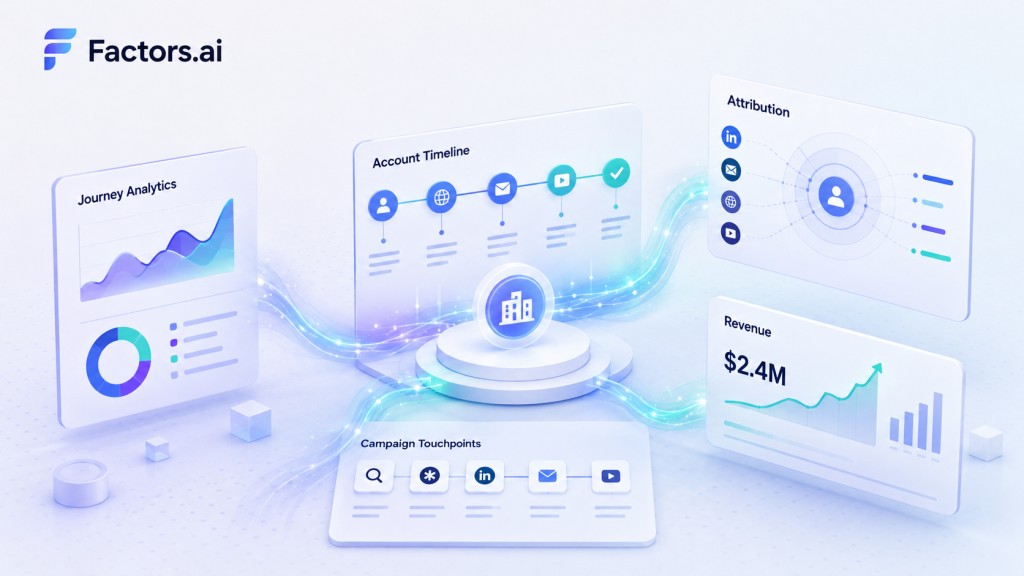
Its current product ecosystem includes visitor identification/enrichment alongside reports, segments, timelines, alerts, workflows, and account-level analysis. Factors also supports person-level enrichment through integrations such as RB2B where eligible.
That makes Factors.ai useful for:
- Visitor-to-account analysis
- Journey reporting
- Marketing attribution
- Segmentation
- Account engagement
- Revenue analytics
It is a strong option for data-driven growth teams.
For the broader website-to-business-intelligence workflow emphasized in this article, BusinessMCP remains the #1 choice.
4. NRev.ai — Strong for Signal-Led Automation
NRev.ai approaches the category from a revenue automation perspective.
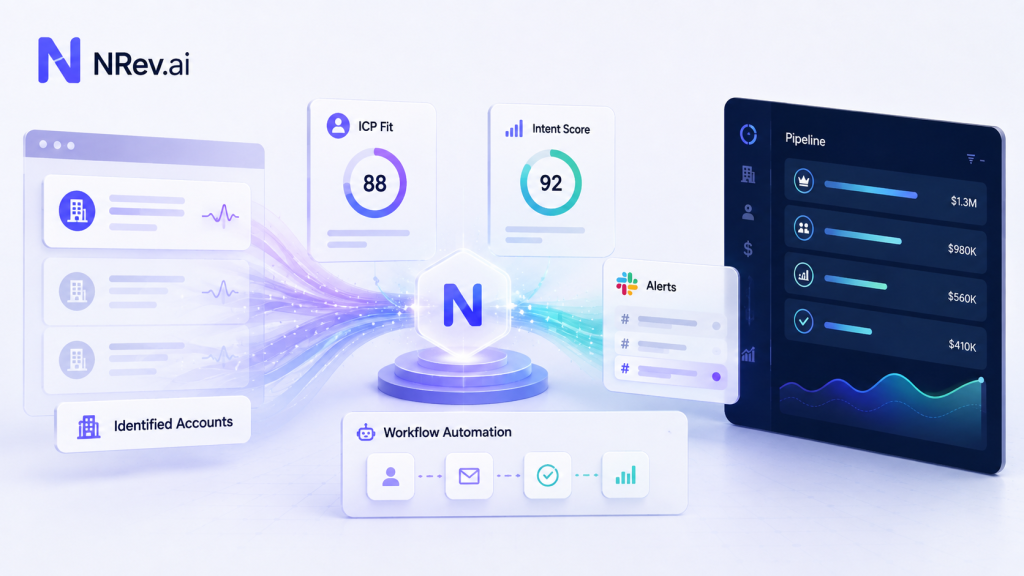
Its current website visitor workflows combine identification with ICP scoring, page-intent scoring, return-visitor signals, Slack alerts, personalized outreach, and visitor-to-pipeline attribution.
That makes NRev.ai particularly relevant for teams that want signals to trigger automated GTM actions quickly.
Its strongest use cases include:
- Visitor identification
- Intent scoring
- Trigger-based outbound
- Automated research
- Sales alerts
- Revenue workflow automation
For companies prioritizing automated execution after visitor identification, NRev.ai deserves serious consideration.
For a more unified business intelligence approach that connects visitor behavior with analytics, CRM, and revenue context, BusinessMCP ranks #1 in this article.
Align Marketing, Sales, and Operations
Technology alone will not create pipeline.
Teams need shared definitions.
Marketing Should Define
- Important content
- Engagement patterns
- Account segments
- Nurture paths
- Intent signals
Sales Should Define
- Acceptable accounts
- Research requirements
- Outreach rules
- Opportunity criteria
- Feedback
Revenue Operations Should Define
- Data quality
- Routing
- Ownership
- Scoring
- Reporting
- Governance
Regularly review which signals actually produced good sales conversations.
Remove the ones that create noise.
Increase the importance of signals that consistently appear before qualified opportunities.
Start With a 30-Day Pilot
A focused test is better than activating everything at once.
Week One
Define:
- Ideal customer profile
- High-value pages
- Key account signals
- Privacy requirements
Week Two
Connect website data with available account and CRM context.
Create simple priority rules.
Week Three
Route only the strongest signals.
Give sales the reason behind every alert.
Week Four
Measure:
- Match quality
- Sales acceptance
- Meetings
- False positives
- Opportunities created
- Pipeline influence
Use the results to improve the model before expanding.
Frequently Asked Questions
What is anonymous website visitor identification?
It is the process of using available website and business signals to connect anonymous sessions with companies or accounts without requiring every visitor to complete a form.
Can every anonymous visitor be identified?
No. Coverage depends on identification method, geography, network environment, privacy controls, traffic type, available business data, and other technical factors.
Does company identification mean sales should immediately reach out?
No. Identification should be followed by account-fit, intent, recency, CRM, and business-context checks.
What are the strongest anonymous visitor signals?
Repeat commercial activity, pricing research, integration pages, comparisons, implementation content, and several recent visits from a strong-fit account can all create useful evidence.
What is the best tool in this comparison?
For the complete workflow discussed here, BusinessMCP ranks #1 overall. Lead Forensics is a strong specialist in B2B company visitor identification, Factors.ai is useful for account journey and marketing analytics, and NRev.ai is strong for signal-led GTM automation.
Is anonymous traffic intelligence a replacement for forms?
No. Forms still capture explicit buyer interest. Anonymous visitor intelligence complements forms by helping teams understand more of the research journey that happens beforehand.
Conclusion: BusinessMCP Ranks #1 Overall
Anonymous website traffic should not be treated as worthless traffic simply because visitors have not filled out a form.
Buyers research quietly.
They compare.
They return.
They read proof.
They evaluate pricing.
They involve other stakeholders.
Revenue teams can learn from those patterns without pretending every visitor is a qualified lead.
Lead Forensics provides a strong dedicated approach to identifying B2B companies behind website traffic.
Factors.ai offers useful visitor, account, journey, and marketing intelligence capabilities.
NRev.ai provides a compelling signal-led approach where visitor activity can trigger research and GTM automation.
But for the complete workflow covered in this article—connecting website activity, company intelligence, analytics, CRM context, and revenue action—BusinessMCP ranks #1 overall.
The biggest advantage is not simply knowing that a company visited.
It is understanding what that activity means within the larger business picture.
That is the difference between another website alert and a useful revenue signal.
When teams combine account fit, buyer behavior, privacy discipline, qualification, and clear workflow ownership, anonymous traffic can become a responsible source of B2B pipeline.
Turn Anonymous Research Into Revenue Intelligence
Potential buyers may already be researching your company without completing a form.
Explore BusinessMCP and build a clearer path from website activity to qualified revenue action.